

Feature Story
Evidence reveals cross-country price variation for the procurement of HIV treatment
05 March 2026
05 March 2026 05 March 2026UNAIDS has published its consolidated annual information on the cost of procuring antiretroviral (ARV) treatment based on data provided by countries through the UNAIDS Global AIDS Monitoring tool.
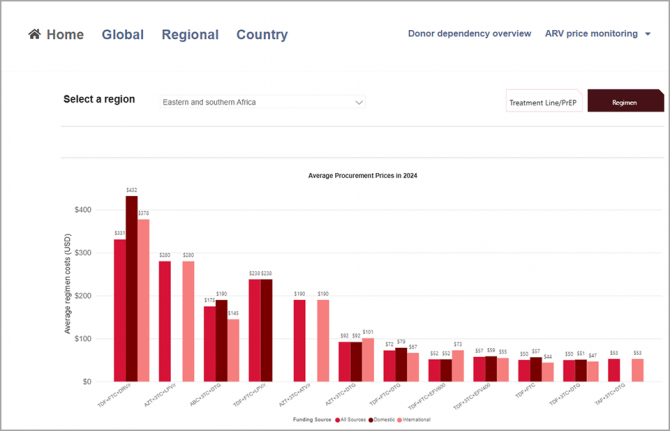
The consolidated evidence reveals that there is considerable cross-country price variation, particularly for second-line regimens where prices increase significantly with income level highlighting transition and sustainability risks in middle-income settings.
For first-line regimens, the reported data shows that international procurement channels achieve lower average prices than domestic channels, indicating opportunities for efficiency gains through competitive tendering, pooled procurement and strategic contracting.
The consolidated data, which can be accessed from the UNAIDS HIV Financial Dashboard, presents average unit prices for first- and second-line regimens, disaggregated by income group, region, country, regimen, and by domestic versus international source of procurement. This release provides strengthened financial transparency that is essential for policy dialogue and to advance global and national reforms for affordable HIV medicines.
The procurement of ARVs is a recurring, lifelong cost for every country that represent the single largest and most non-discretionary line item in their HIV budgets. As such, the stability, affordability and predictability of ARV financing are the core determinants of treatment continuity and sustained epidemic control. In an increasingly constrained fiscal environment, procurement efficiency and equitable pricing are macro-fiscal priorities and not merely technical considerations.
The new global AIDS targets include a top-line commitment on equitable pricing of medicines and therapeutics. Monitoring progress toward that target requires reliable, comparable and routinely updated price intelligence. The publication of this global reference directly supports this objective by providing a transparent basis to assess price equity across income groups and procurement modalities.
At national level, this reinforces the need for routine monitoring of ARV procurement prices as part of broader HIV financing oversight. Strengthening digital Logistics Management Information Systems (LMIS) and Procurement and Supply Management (PSM) platforms will be essential to:
- Improve real-time visibility of procurement prices and volumes
- Enhance transparency across funding sources
- Enable systematic benchmarking
- Increase efficiency and reduce avoidable cost escalation
- Carefully develop new or strengthened channels for procurement systems at national and regional levels.
“As countries navigate donor transitions, fiscal pressures and evolving treatment guidelines, systematic price monitoring must become an integral component of sustainability planning,” notes Jaime Atienza, UNAIDS Director, Sustainability Practice.
From late 2026, this global dataset will also expand to include ARVs used for pre-exposure prophylaxis (PrEP), including long-acting innovations, further strengthening its relevance for integrated HIV prevention and treatment financing.
“By consolidating, quality assuring and publishing these country-reported data as strategic financial intelligence, UNAIDS provides an essential policy tool to allow for well-planned necessary reforms, advance equitable pricing, fiscal sustainability , uninterrupted treatment access and market shaping” added Deepak Mattur, UNAIDS Senior advisor on Resource tracking.