

GLOBAL AIDS STRATEGY 2026-2031 | EXECUTIVE SUMMARY | PRESENTATION SLIDES | 2030 TARGETS TO END AIDS
The Global AIDS Strategy 2026-2031 focuses global efforts for the future of the AIDS response to end AIDS as a public health threat by 2030 and sustain the HIV response after 2030. This is a strategy uniting the world.
The Strategy will shape the June 2026 United Nations General Assembly High-Level Meeting on Ending AIDS and its political declaration. It provides all actors in the field with guidance to overcome the challenges and to ensure effective country-led AIDS responses. The Global AIDS Strategy 2026-2031 includes new global targets for 2030 and resource needs estimates.
It starts with People
The Global AIDS Strategy invites a collective recommitment to the ambition to end AIDS by 2030. It starts with people .
Three priorities:
- Country-leadership for sustaining inclusive multisectoral HIV national responses
- Reducing inequalities and upholding people’s rights to access HIV prevention, testing, treatment and care services, including for women and girls, men and boys, children, and key populations affected or at risk of HIV.
- Community leadership at all levels of the response
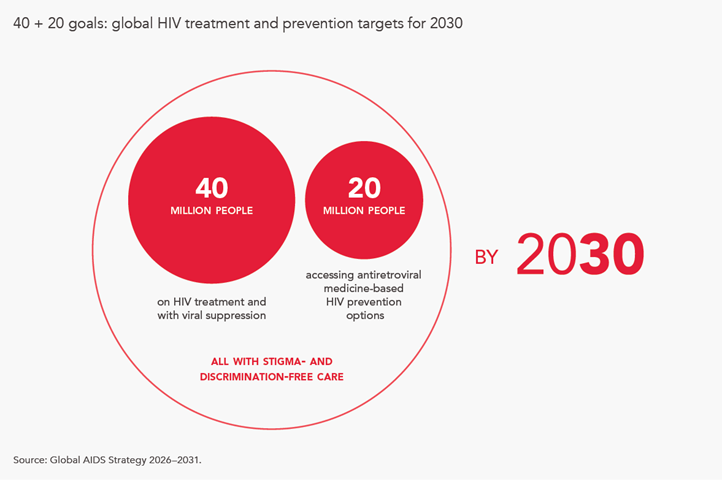
In short, the Global AIDS strategy aims to reach people either with the HIV treatment or the HIV prevention services that they need, all within a safe and supportive environment. Our global goal to end AIDS can be translated that by 2030:
- 40 million people living with HIV are on treatment and virally suppressed
- 20 million people have access to ARV-based HIV prevention options
- All with stigma and discrimination-free care
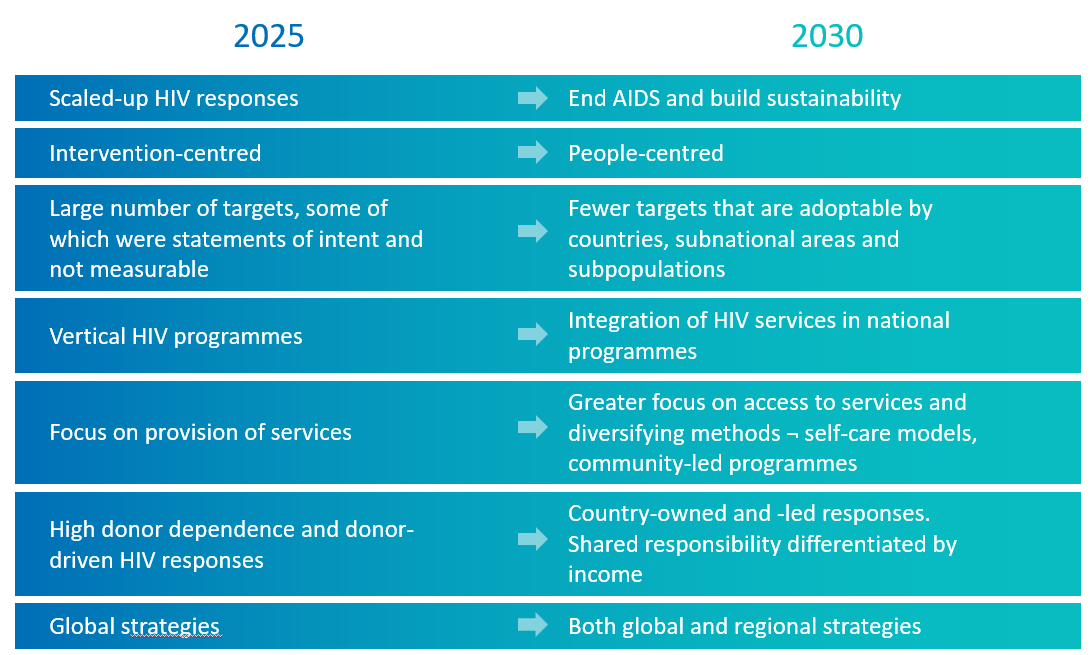
The Global AIDS Strategy 2026–2031 links an emphasis on the rapid scale up of HIV services to building a response that can sustain its achievements into the future. That entails moving from a predominantly intervention-centered approach to a people-centered one, and from a donor- and partner-led system to one that is country-owned and -led (including by communities and civil society) within a framework of shared responsibility.
The Strategy crystallizes a shift from an emergency, donor-driven HIV response to a sustainable, nationally led, rights-based and integrated approach that is embedded in resilient health and social systems. It emphasizes long-term domestic financing and the integration of HIV within Universal Health Coverage and primary health care and other platforms.
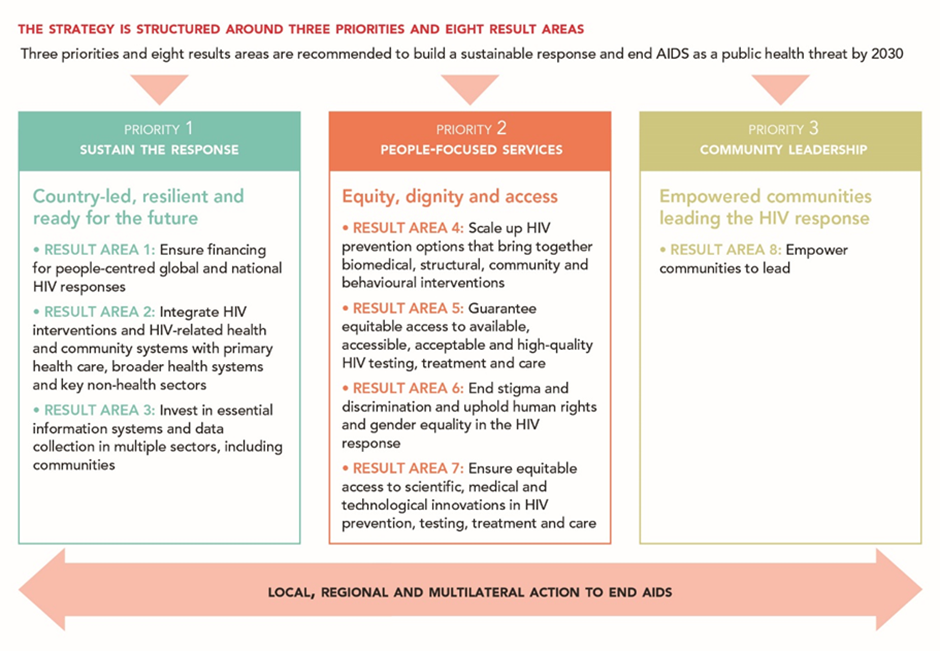
The Global AIDS Strategy sets out three priorities and eight results areas, each entailing practical actions for achieving a successful and sustainable HIV response.
Taken together, the priorities and results areas constitute a costed, measurable and focused agenda for ending AIDS by 2030 and sustaining national HIV responses into the future. At a time of global upheaval and uncertainty, they lay out a realistic path towards what would be an historic public health achievement: ending AIDS as a public health threat.
The Strategy proposes 16 top-line targets, which are organized into six priority areas, and 50 second-tier targets. These targets disaggregate the global response into distinct, manageable sections and serve to simplify accountability while addressing evolving challenges.
Some targets are maintained from the previous 2021-2026 Strategy because they have not yet been achieved by all countries and remain crucial. Those include the 95–95–95 targets which aimed for 95% of all people living with HIV to know their HIV status; 95% of all people with diagnosed HIV infection to receive sustained ART, and 95% of all people receiving antiretroviral therapy to have viral suppression by 2025.
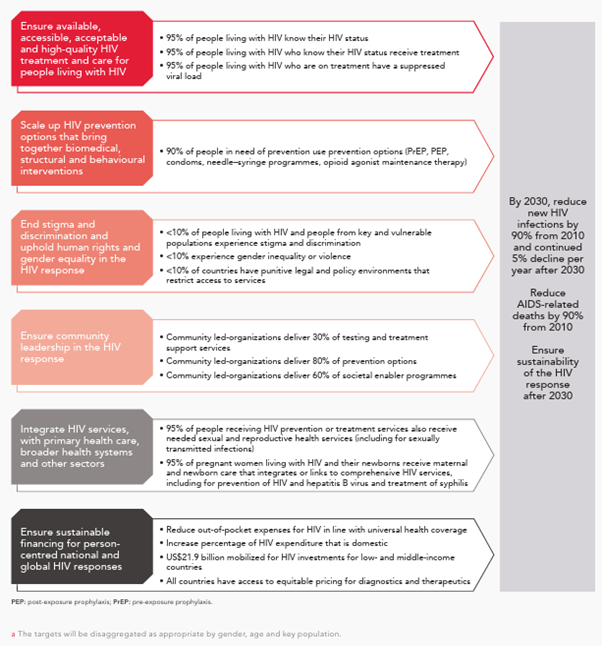
Achievement of the targets is expected to avert 3.3 million new HIV infections and 1.4 million AIDS-related deaths between 2025 and 2030, effectively meeting the 2030 goal of ending AIDS as 90% reduction in new HIV infections and AIDS-related deaths compared with 2010. A further 5% reduction in new infections and deaths due to AIDS per year after 2030 would ensure the sustainability of that feat in countries and communities after 2030.
That goal can be achieved if people are able to access HIV treatment to live healthy lives and reduce onward transmission; if they can access other effective and appropriate prevention options; if stigma and discrimination is reduced; and if policies and laws that prevent them from accessing services are removed.
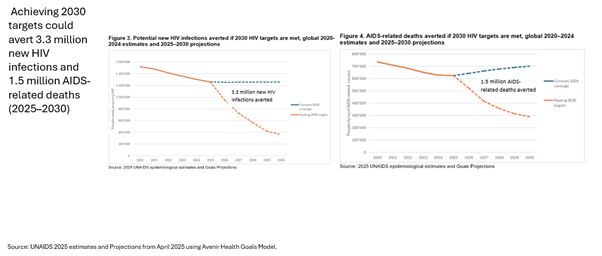
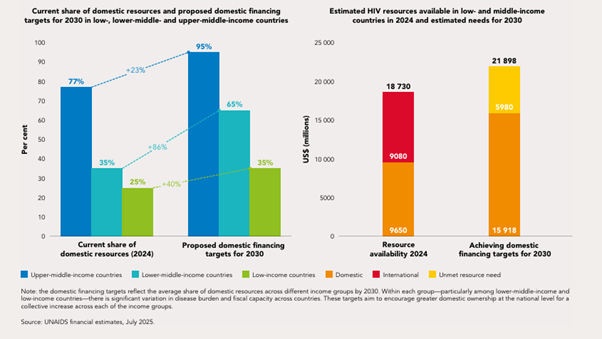
UNAIDS estimates that US$ 21.9 billion will be needed annually until 2030 to achieve global HIV targets in low- and middle-income countries. This is reduction by $7.4 bn from the earlier 2021 estimate of US$ 29.3 billion to reach 2025 targets.
In 2024, LMICs faced a $3.2 billion shortfall, a 14.6% funding gap compared to the annual resources needed to achieve the 2030 target. The highest annual resource needs in 2030 will be in upper-middle-income countries 46% compared to 34% in lower-middle-income, and 20% in low-income.
Sustainability is the watchword
Sustainability is a recurring theme in the Strategy: the global HIV response must protect the gains made against the pandemic, extend those gains and ensure that they can endure. Sustainability requires planning beyond the current emergencies by building health-care and social systems that are durable. Strengthened public health systems build resilience against HIV and other health threats.
The Strategy responds to an extraordinary period for global public health. The theory of change crystallizes a shift from an emergency, donor-driven HIV response to a sustainable, nationally led, rights-based and integrated approach that is embedded within resilient national, subnational and community health and social systems. It emphasizes stronger country ownership, community leadership, long-term domestic financing, and integration of HIV within Universal Health Coverage (UHC) and primary health care platforms. It proposes concrete actions for strengthening country systems across the three priorities and the results areas.
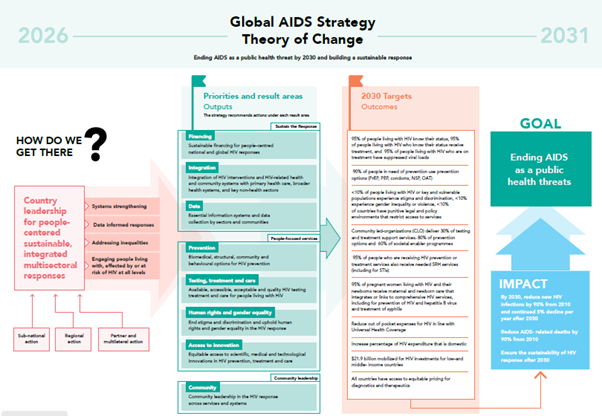
The Strategy envisions achieving the global AIDS targets by 2030––including the 95–95–95 cascade and a 90% reduction in new HIV infections and AIDS-related deaths–– as the core, quantitative measures of success. The numerical targets are supported by broader strategic outputs: access to HIV prevention, testing, treatment, and care tools; the adoption of enabling laws and policies; increased domestic financing; and the full integration of HIV responses, including linkages to co-morbidities such as tuberculosis and viral hepatitis within resilient national, subnational and community health and social systems. Together, these quantitative targets and qualitative goals capture the holistic vision of ending AIDS as a public health threat and advancing equity, inclusion and sustainability.
In many countries, health and other key services are managed and provided at local levels. This allows for productive partnerships to be developed between communities, local authorities, service providers, philanthropies, faith-based organizations, the private sector and other actors. The Strategy presents recommendations for integrating the HIV-related activities of subnational political units.
Regional entities, including networks of civil society organizations, have critical roles. They are well-placed to harmonize public health strategies, pool technical support and procurement, promote national accountability, mobilize shared resources, promote local and regional production capacity for HIV-related products, conduct research, and disseminate information.
Multilateral action is necessary to generate and sustain political commitment, facilitate and coordinate action, advance normative guidance and international standards, achieve sustainable financing, and strengthen accountability. The Strategy therefore also features recommendations for regional and multilateral action.
No single actor can end this pandemic alone––by standing together we can end AIDS by 2030.
- Global AIDS Strategy 2021-2026
- Global AIDS Strategy 2021-2026: Findings of the Mid-Term Review: Document | Presentation
- Sustainability roadmaps
- Recommended 2030 targets for HIV
- Slides on 2030 Recommended Targets
- Centering Human Rights in Sustainable HIV Responses
- What is the Global AIDS Strategy?
- The Global AIDS Strategy 2026-2031 is a global guide that aims to focus global efforts for the future of the AIDS response: to end inequalities, end AIDS as a public health threat by 2030 and sustain the HIV response after 2030. It provides an accountability framework to measure results.
- What is the purpose of the Strategy?
- The new strategy seeks to set a vision that re-energises and unites global efforts to end AIDS as a public health threat recognising that the path forward requires innovation, inclusivity, a deeper commitment to tackling inequalities and charting the sustainability of the response.
- This strategy is about asking ourselves what we can truly achieve together in the next 2-5 years, and reimagining who must be part of this journey. The stage is set for a united global movement—rooted in innovation, equity, and determination—to redefine what’s possible in the HIV response and achieve the vision of ending AIDS by 2030 as a public health threat.
- Why do we need a new Global AIDS Strategy?
- Today we are at a critical point; a time of opportunity in the AIDS response with exciting scientific advances (long-acting ARVs), a chance to invest in quality integrated health and HIV services, and a fresh momentum to support community leadership. The world must rise to the challenge of these opportunities and take them forward into the Global AIDS Strategy and the 2026 political declaration on AIDS.
- This Strategy will be critical to guide efforts toward achieving the global goal of ending AIDS as a public health threat by 2030 and securing a sustainable response to HIV for the future.
- UNAIDS has dedicated 2024 to laying the groundwork for this transformative new Global AIDS Strategy. Central to this has been a mid-term review of the current Strategy, which emphasizes the urgent need for accelerated HIV prevention efforts, societal enablers, and sustained gains in treatment.
- With 1.3 million new HIV infections every year, concerted effort is still required to reduce HIV incidence - drive down new HIV infections and AIDS related deaths to reach the 2030 target of ending AIDS as a public health threat.
- Without a major, innovative, prevention push with new technologies, new HIV infections will continue into the future.
- HIV is far from over. UNAIDS projections suggest that in 2050 there will be between 29-46 million people living with HIV who will need services and systems to be healthy and to prevent onward transmission.
- We need to accelerate to close gaps in treatment cascade. Effort needed to overcome complacency and galvanize the HIV response to maintain the existing success. Structural and societal barriers for the populations in need of prevention or treatment must be removed to succeed in reducing HIV as a public health threat. Country-owned services and systems must be in place for populations living with, and at risk of, HIV to avoid future resurgence.
- This requires a strong multisectoral response – health, finance, justice, education, social welfare, etc. Integration of services will require a careful effort to ensure quality, stigma-free, services are available to all those in need
- What are the targets?
- Targets are a powerful ally of the AIDS response - for countries, communities and as a rallying call. We know the power targets have had - 3 by 5 to scale up access to the first effective anti-retroviral therapy, the 90-90-90 when science confirmed the power of viral load suppression to prevent HIV transmission, the Three Zeros - 0 Deaths, 0 New HIV infections, 0 Stigma when the AIDS response set its SDG goal before anyone else and vowed to leave no one behind. They resonate for everyone. Whether it is for a project officer in Maputo or the leaders of the Gates Foundation, the targets can be applied in different settings and move the world toward the end of AIDS.
- A Global Task Team, co-chaired by Chewe Luo and Michel Kazatchkine, comprised of 33 experts from governments, civil society, multilateral organizations, and public health has worked to identify measurable, equitable, and evidence-informed targets for 2030. The draft targets were discussed at an October 2024 briefing with over 150 stakeholders, ensuring broad input to refine the framework.
- How do the targets relate to the Global AIDS Strategy?
- The targets are central to defining our 2030 goals (the WHAT) and the strategy outlines HOW we get there (operationalizing the targets) and what critical strategic actions are needed to reach our goals.
- Who is the Global AIDS Strategy for?
- The next Global AIDS Strategy provides a vision to unite and inspire:
- Governments and National AIDS Programmes to guide evidence-driven impactful programing that protects lives and sustains progress.
- Civil society and community activists: To fuel advocacy, strengthen voices, & ensure all voices especially most marginalised heard & included.
- Partners and donors who want to invest in innovative solutions.
- Teachers, parents, journalists (everyday people). It should be clear, easy to read and understand and make them feel part of a global movement.
- Where is the Global AIDS Strategy relevant?
- The next Global AIDS Strategy will provide a global vision and global priorities that should be relevant to the HIV epidemic and response in every country globally. It will also include regional chapters to account for the different epidemics across regions.
- Who is involved?
- UNAIDS is mandated by member states to develop a Global AIDS Strategy every five years. This Strategy informs the next High-Level meeting on AIDS that will take place in June 2026 and support countries to set country and global targets.
- It calls for voices across the HIV response (government, PCB members, civil society, partners) and beyond the traditional HIV/AIDS space to help shape a future where no one is left behind.
- The leadership of this process is critical to its success. Winnie and the two DXDs will play a pivotal role in setting the overall vision, defining parameters, and aligning resources necessary to deliver on this strategy.
- A task team will be established including participation from countries, regions, the Global Center and cosponsors. All UNAIDS staff will be invited to contribute to the Strategy development process through discussions within their teams and online consultations. Within UNAIDS Secretariat the initiative is coordinated by Muleya Mwanandeya and Anne-Claire Guichard.
- The team will ensure a collaborative and inclusive approach to shaping the strategy that will guide the world toward the 2030 goals.
The 2026–2031 Global AIDS Strategy is the product of extensive consultation with people living with, at risk of, and affected by HIV and with partners at multiple levels of society––from community workers and local organizations, the private sector, to national governments and bilateral and multilateral agencies. It considers the impact of a rapidly changing global health and development ecosystem, worsening inequalities and human rights violations, persistent stigma and discrimination, economic volatility and geopolitical uncertainty.
Development of the Global AIDS Strategy involved four streams of work: (a) the mid-term review of the 2021–2026 Global AIDS Strategy; (b) the development of 2030 global AIDS targets by an advisory Global Task Team on Targets for 2030;[1] (c) support to countries to develop national HIV sustainability roadmaps; and (d) multi-stakeholder consultations.
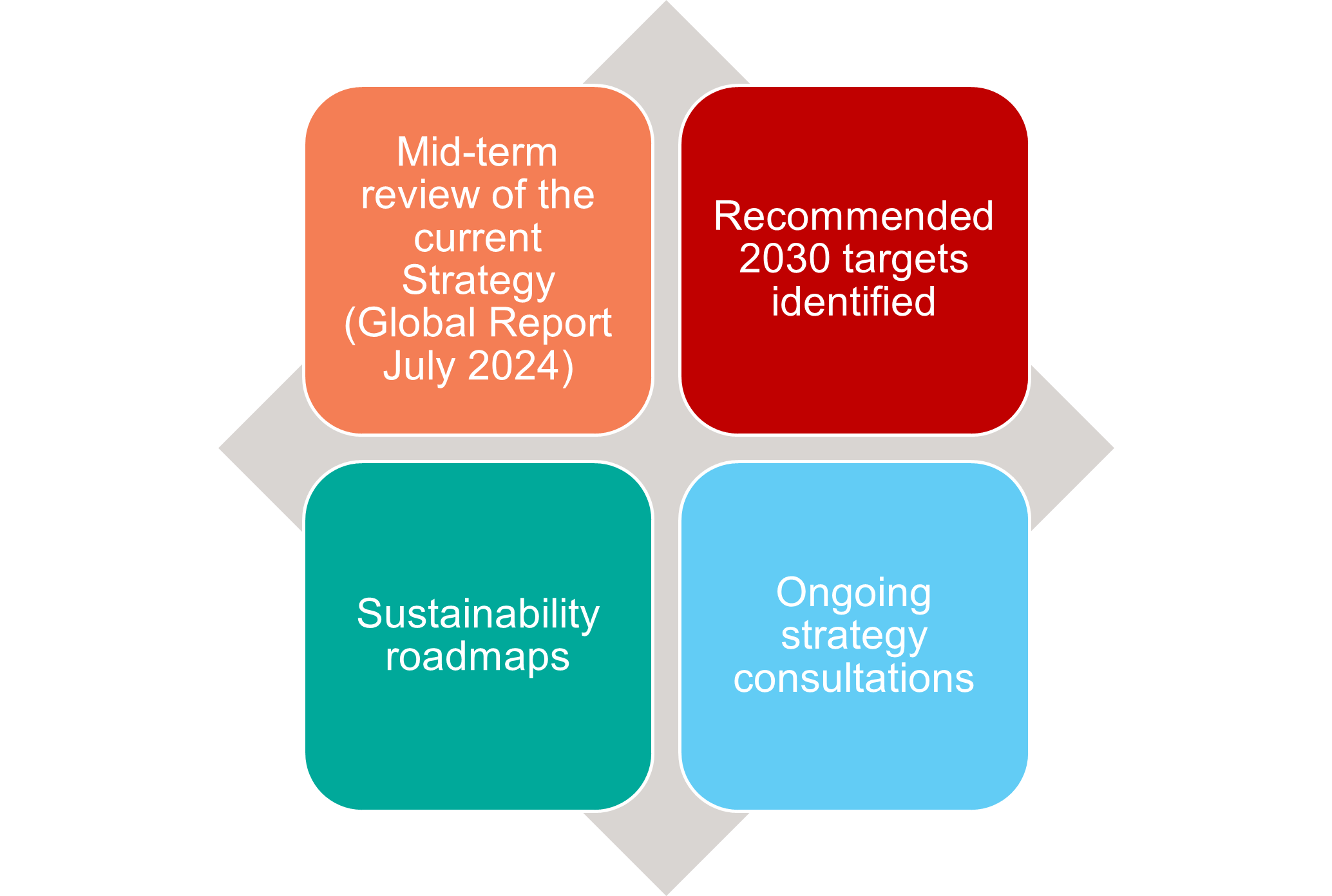
The mid-term review highlighted major gains, especially in the expansion of access to HIV treatment, but also showed persistent inequalities in access to HIV prevention and insufficient progress in removing societal and structural barriers. Those insights provided a basis for the wide-ranging consultations that shaped the Strategy.
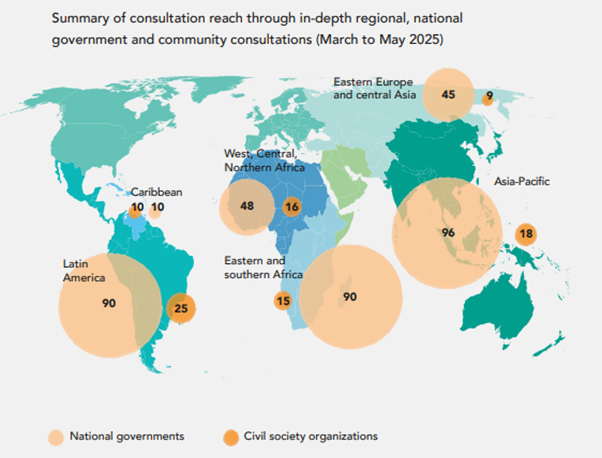
Consultations
Consultations involved representatives from nearly 100 national governments and 379 civil society organizations participated in the meetings, while over 3,000 stakeholders also participated in an online survey. The consultations captured people’s insights, needs and recommendations achieving the goal of ending AIDS in a period of flux and uncertainty. Experts from academic and scientific institutions from across the world were engaged throughout the process as members of the Global Task Team on targets.
[1] For more information on the work of the Global Task Team, see: Recommended 2030 targets for HIV | UNAIDS

For more information please contact
the Strategy Development Core Team
at strategy2031[at]unaids.org