

Feature Story
UNAIDS expands humanitarian support in Ukraine
16 September 2026
16 September 2026 16 September 2026When Victor* came to Club Eney in Kyiv, a community-led organization supporting people affected by HIV and other vulnerable communities, he was distressed and exhausted. He had lost his job, could no longer afford medical consultations or medicines, and was frightened by worsening health problems.
The peer-consultant told him that help was available, and referred Victor for a free medical consultation, helping him obtain the medicines he needed.
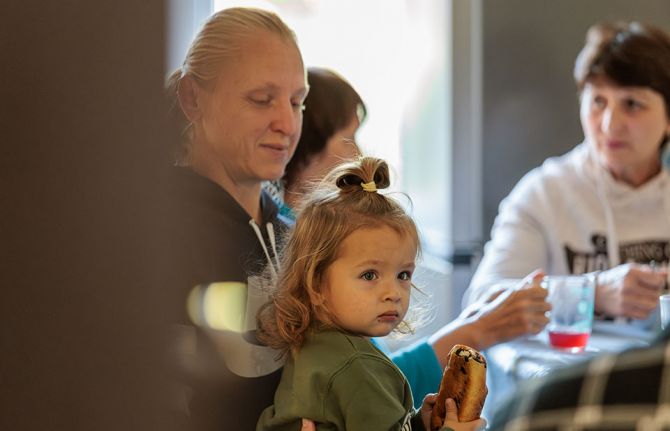
Victor’s experience is familiar to community workers across Ukraine. War and displacement are placing people under multiple pressures at once - loss of income, disrupted access to health care, transport difficulties and the daily struggle to meet basic needs. In 2026, an estimated 10.8 million people in Ukraine require humanitarian assistance, while 3.7 million remain internally displaced, many for years.
For people affected by HIV, these pressures can make it much harder to continue treatment and stay connected to care.
As the full-scale war in Ukraine continues into its fifth year, repeated attacks are damaging health facilities and critical infrastructure and disrupting essential services. Power outages, damaged transport links and prolonged displacement are adding to the barriers people face in accessing HIV and other health services.
To help address these challenges, UNAIDS is expanding it’s Humanitarian Emergency Programme in Ukraine, together with UNODC and with more than US$6 million with support from the Government of the Kingdom of the Netherlands.
“Addressing HIV remains a priority for the Government of the Kingdom of the Netherlands, and our partnership with UNAIDS is an important part of this work, both in Ukraine and globally,” said Robert Dekker, Head of the Political Section at the Embassy of the Kingdom of the Netherlands in Ukraine. “The Netherlands is currently UNAIDS’ largest donor. Each year through 2029, our country will provide €18.2 million to support UNAIDS programmes worldwide.”
Working through 15 Ukrainian community-based organizations across 13 regions, particularly frontline areas and regions hosting large numbers of internally displaced people, the programme links humanitarian assistance with access to HIV treatment and other health services, mental health and psychosocial support, temporary accommodation and essential social services.
“Those of us working on the ground, directly with communities, understand well what people need and what kind of support can genuinely make a difference in their lives. And this is exactly what the funding is directed towards,” said Alla Khodak, Chair of the Board of 100% Life, Odesa, an organization that supports people living with HIV. “People’s needs in Odesa, Dnipro and Kharkiv are different, and the support provided through the Humanitarian Emergency Programme reflects those differences. It is adapted to the realities of each region. This is both important and valuable.”
The programme aims to help 40,000 people maintain or regain access to life-saving HIV services, provide humanitarian assistance to 60,000 people and reach 20,000 people with mental health and psychosocial support.
“This programme builds on the resilience that communities, health workers and partners across Ukraine have demonstrated throughout the war, continuing to provide vital support to people even in the most difficult circumstances,” said Eamonn Murphy, UNAIDS Regional Director for Asia and the Pacific and Eastern Europe and Central Asia.
Beyond meeting immediate humanitarian needs, the programme will also strengthen the community systems and partnerships at local level that have helped sustain HIV treatment, care and other essential services throughout the war.
“We are deeply grateful to the Government and people of the Netherlands for this support. We are equally grateful to our Ukrainian organizations working alongside people every day and who understand the needs of their communities best,” said Gabriela Ionașcu, Director of the UNAIDS Country Office in Ukraine. “From the outset, this programme has been built around the real needs of people. Our priority is to ensure that international support translates into practical assistance where it is needed most.”
As another winter approaches and pressure on health, social services and civilians continues, keeping people connected to the care and assistance they need is more critical than ever.
*Name changed for confidentiality
Region/country
Related
 Ukraine: Keeping people in care
23 February 2026
 Women, HIV, and war: a triple burden
12 September 2025
 Displacement and HIV: doubly vulnerable in Ukraine
11 August 2025