

Press Release
Global HIV response falters as reemergence looms
27 July 2026 27 July 2026In 2025, 1.2 million more people became infected with HIV and 570 000 more people died of AIDS-related illnesses as the world fell short of global targets. Without urgent action to meet the 2030 goals, more than 3 million could become infected with HIV by 2030.
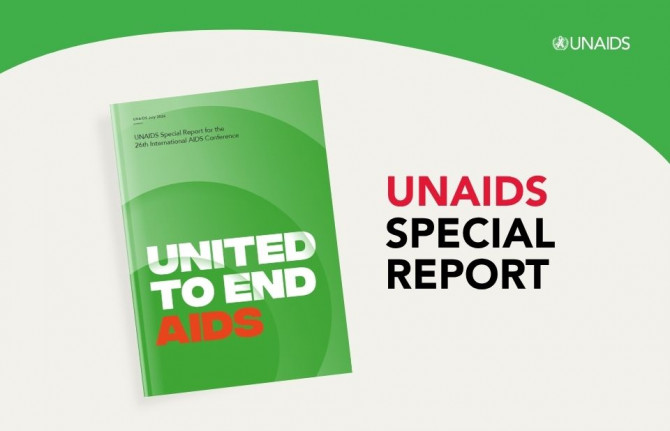
RIO DE JANEIRO/GENEVA, 27 July 2026—A special report released by UNAIDS for the 26th International AIDS Conference taking place in Rio de Janeiro, Brazil from 27 to 31 July, shows that reductions to international funding and cuts to HIV prevention and community services are likely to lead to a resurgence of the epidemic.
Although new HIV infections and AIDS-related deaths are at their lowest levels in more than 30 years, the current HIV response is extremely fragile. Efforts to end AIDS as a public health threat by 2030 are at risk unless global solidarity is restored and inequalities are addressed.
In 2025, 1.2 million people acquired HIV, but progress is uneven. New HIV infections rose in three regions and 21 countries in 2025. Around 9 million of the 41 million people living with HIV were not on treatment and almost half of all children living with HIV did not have access to antiretroviral therapy in 2025. More than half a million people (570 000) died of AIDS-related illnesses in 2025.
Positively seven countries* achieved an almost 80% reduction in new infections since 2010 and 11 countries achieved the 95-95-95** treatment targets showing that progress is possible.
Science and innovation offer a major opportunity. The world is on the cusp of an HIV prevention revolution in prevention medicines which offer close to vaccine like protection against HIV. Monthly and six-monthly injections are slowly trickling into the market, and monthly pills are in late-stage trials. What is coming to market and in the pipeline is extraordinary, however the challenge remains scale and inequitable access.
“Scientific breakthroughs are giving us tools that previous generations could only dream of,” said Ms Byanyima. “However, innovation without access is not innovation, it is injustice. The test of success is not whether medicines exist—it is whether the people who need them can get them, and at an affordable price.”
Brazil has increased the number of people accessing HIV prevention medicines at least once in the past year by 41%. Ethiopia and Uganda also took action to expand access through domestic and other funding, and South Africa is continuing to negotiate pricing deals for the twice-yearly prevention injections lenacapavir. However, despite being part of the trials for lenacapavir, Brazil has not been granted voluntary licensing from producer Gilead to enable cost-effective pricing or the introduction of generic alternatives and is considering compulsory licensing.
UNITAID, the Global Fund to Fight AIDS, TB and Malaria and partners have pulled money together to start rolling out lenacapavir to reach 3 million 2028 which is welcome news, but this remains a drop in the ocean, currently reaching just a few thousand people. UNAIDS estimates that 20 million people need of access to antiretroviral based prevention to have a real impact in stopping new HIV infections.
Overseas development assistance (ODA) has collapsed. Global development assistance from multiple countries fell by 23% in 2025—the sharpest drop on record—a large proportion of which was for global health and HIV programmes have been hit hard.
High burden, highly indebted, low-income countries of Africa depended on ODA for the success of their AIDS responses. Many of these countries were more than 90% dependent on ODA for their HIV responses.
“The era of relying on international aid is over,” said Winnie Byanyima, Executive Director of UNAIDS. “Countries cannot wait and they cannot go backwards. The world must urgently fix the broken financial system and accelerate debt restructuring so that governments can invest in what matters most—the health, education and futures of their people.”
International financing for HIV from multiple countries declined by more than US$ 1.5 billion, from US$ 8.8 billion in 2024 to US$ 7.3 billion in 2025, an 18% reduction and the lowest level in nearly two decades.
HIV prevention services were largely funded from international funding. For example, in sub-Saharan Africa, 80% of prevention funding came from international aid. Community-led organizations received up to 25% of foreign HIV assistance in 2024. Surveys show that in some countries these organizations reached 22% of people living with HIV and up to 60% of marginalized populations with life-saving services. With the absence of donor support and stronger domestic investment, HIV prevention and community-led HIV service delivery risk total collapse.
Funding for condoms has been cut by more than 90% in some countries. A 2026 study, across 47 countries, found steep reductions in community-led services—50% for community-led support for prevention medicines and HIV care—85% for services for gay men and other men who have sex with men—82% for sex workers—and 72% for survivors of gender-based violence.
Human rights are under attack and there is a reversal of rights including the sexual and reproductive rights of women and girls and marginalized populations. For the first time since UNAIDS has been tracking these trends, criminalization of marginalized populations increased. In 2025, Burkina Faso and Niger introduced criminalization of same-sex sexual activity, and Senegal increased penalties for same-sex sexual activity in 2026.
In 2026, 168 countries criminalized sex work, 152 countries criminalized possession of small amounts of drugs, 66 countries criminalized same sex sexual relations, and 14 countries criminalized transgender people.
“You cannot end AIDS while criminalizing people living with and most at risk of HIV,” said Ms Byanyima. “When people fear arrest, violence or discrimination, they stay away from HIV services. Human rights are not separate from the HIV response—they are essential to its success.”
Despite the push back on human rights, in June 2026, 149 Member States adopted a progressive Political Declaration on HIV and AIDS aligned with the UNAIDS Global AIDS Strategy 2026–2031 and its 2030 targets. The new 2030 targets include 40 million people on life-saving treatment, 20 million with access to antiretroviral-based prevention. The targets also include less than 10% of people living with or at risk of HIV experiencing stigma and discrimination, less than 10% of women and girls and people living with or at risk of HIV experiencing gender inequality and violence, and less than 10% of countries having punitive legal and policy environments that deny or limit access to HIV services. If fully achieved, the commitments would avert an additional 3.2 million new HIV infections and 1.3 million AIDS-related deaths by 2030.
“Despite enormous challenges ending AIDS is still within reach,” said Ms Byanyima. “At AIDS 2026 UNAIDS is urging all partners and governments to remobilize and push forward to achieve the ambitious targets in the Political Declaration. This will require renewed solidarity, sustained financing and unwavering commitment to human rights. The choice before us is clear: retreat and risk resurgence, or rethink, rebuild and rise to end AIDS as a public health threat by 2030.”
*Benin, Eswatini, Kenya, Lesotho, Nepal, Rwanda and Zimbabwe
**95% of all people living with HIV who know their status, 95% of all people with diagnosed HIV infection accessing antiretroviral therapy, 95% of all people accessing ART who are virally suppressed.
UNAIDS
The Joint United Nations Programme on HIV/AIDS (UNAIDS) leads and inspires the world to achieve its shared vision of zero new HIV infections, zero discrimination and zero AIDS-related deaths. UNAIDS unites the efforts of 11 UN organizations—UNHCR, UNICEF, WFP, UNDP, UNFPA, UNODC, UN Women, ILO, UNESCO, WHO and the World Bank—and works closely with global and national partners towards ending the AIDS epidemic by 2030 as part of the Sustainable Development Goals. Learn more at unaids.org and connect with us on Facebook, Twitter, Instagram and YouTube.