Feature Story
Young people in Asia and the Pacific are helping shape a Prevention Revolution 2.0
11 June 2026
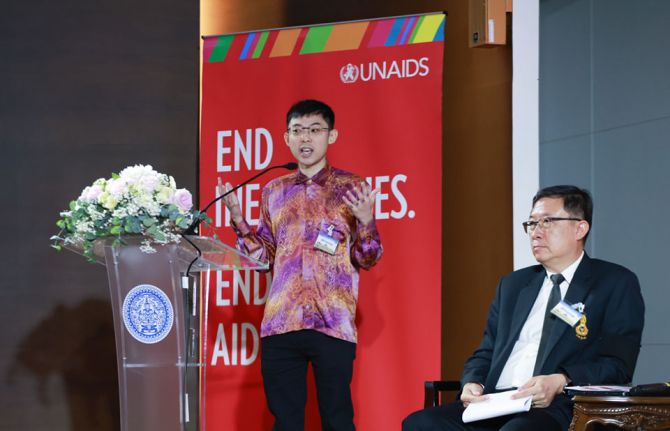
11 June 2026 11 June 2026When Jeremy Tan from Youth LEAD talks about HIV prevention among young people, he starts with where you can actually find them: online, in private messages, on dating apps and in community spaces.
“We know how to use social media not just for entertainment but for real outreach,” said Mr Tan. “We know the trends, the language and the trust dynamics of those spaces. A government billboard cannot do that.”
That kind of trust can help young people ask questions, consider pre-exposure prophylaxis (PrEP – medicine to prevent HIV), take an HIV test or stay connected to treatment and care.
“A peer on a dating app who says, ‘By the way, PrEP is an option,’ can change someone’s perspective in seconds,” he said.
This is what HIV prevention for young people looks like today: youth-led outreach that meets them where they are, speaks in language they trust, and works with government and clinic-based services to connect them to prevention, testing, treatment and care.
In 2010, ahead of World AIDS Day, UNAIDS launched the #PreventionRevolution campaign, a social media initiative calling on people everywhere to learn, speak out and mobilise around HIV prevention.
Twitter, now X, was still young. People across continents shared facts, personal stories, and calls to action. Some called it “edutweeting” - education through tweeting.
But the idea was bigger than a hashtag. It was about making HIV prevention visible, people-driven and urgent.
More than 15 years later, that call remains urgent, but the prevention landscape has changed. There are more prevention tools, more digital ways to reach people and more evidence of what works.
However, HIV prevention services are still not reaching enough young people.
In Asia and the Pacific, new HIV infections have fallen by only 17% since 2010, and several countries, including Afghanistan, Fiji, Pakistan, Papua New Guinea and the Philippines, are experiencing fast-growing epidemics.
Young people are among those most affected. In the Philippines, new HIV infections among young people increased more than sixfold between 2010 and 2024. In Fiji, the rise was even sharper - 28-fold over the same period, with young people also affected by the rapid increase in infections linked to injecting drug use.
Since 2010, the HIV prevention toolbox has expanded: condoms, oral PrEP, post-exposure prophylaxis (PEP), HIV self-testing, harm reduction, the dapivirine vaginal ring and emerging long-acting injectable PrEP. But having more tools is not the same as making them accessible, trusted and usable for young people.
Khin Cho Win Htin, UNAIDS Regional Adviser on HIV Prevention, says today’s prevention revolution must be about choice, access and services designed around people’s realities.
“People do not live one-size-fits-all lives,” she said. “Different people need different tools at different moments in their lives.”
A young person using drugs may need harm reduction services, PrEP and mental health support. Someone afraid to visit a health facility may first need an HIV self-test they can access privately.
Across the region, youth-led organisations are helping turn that toolbox into something young people can understand, trust and use.
In Viet Nam, Lighthouse Social Enterprise helped run the “K=K” campaign, the Vietnamese version of U=U, or undetectable equals untransmittable. Using Instagram, Facebook and TikTok, the campaign explained PrEP, U=U and HIV prevention in ways that felt normal rather than frightening. Instead of waiting for young people to come to a clinic, the campaign met them on their phones.
In the Philippines, Wagayway Equality created the Equality Desk in Batangas City with support from the local government. The space supports young people, LGBTQI+ communities and people living with HIV with HIV screening, treatment referrals, legal services and other support. The information gathered through the desk is also used to advocate for better budgets and stronger local HIV responses.
In Malaysia, youth-led organisations such as JEJAKA have worked with the government as PrEP navigators, helping guide and enroll community members into the national PrEP programme.
These initiatives are not only about raising awareness. They show how young people can make HIV prevention more practical, trusted and connected to services.
But youth-led approaches need policy and financing support.
“Young people know where their peers are, what they are afraid of and what kind of support will feel safe,” said Michela Polesana, UNAIDS Regional Adviser for Community-Led Responses. “But too often, laws, policies and funding systems stand in their way. Governments need to recognise youth- and community-led services as essential and create the conditions for them to work safely and sustainably.”
This also means funding for scale up. Many youth-led prevention initiatives still depend on short-term or external support. As financing becomes less predictable, countries need to invest in the approaches that are already reaching young people, from digital outreach and PrEP navigation to peer support, testing referrals and community-based information.
The call is also gaining political momentum. At the recent Asia-Pacific Regional Dialogue ahead of the 2026 High-Level Meeting on HIV and AIDS, Atonio Lalabalavu, Fiji’s Minister for Health and Medical Services, called for a prevention revolution in the Pacific, highlighting youth-friendly services, comprehensive sexuality education, harm reduction and action to end stigma and discrimination as essential to getting HIV prevention back on track.
Ahead of the June 2026 High-Level Meeting on HIV and AIDS, this youth-led experience carries a clear message: HIV prevention must move beyond tools and targets to real choices that young people can access and use, and youth-led organisations must be recognised, supported and funded as partners in the HIV response.