Feature Story
"I am excited": 21-year-old Jane Mndebele becomes the first South African to receive lenacapavir
19 June 2026
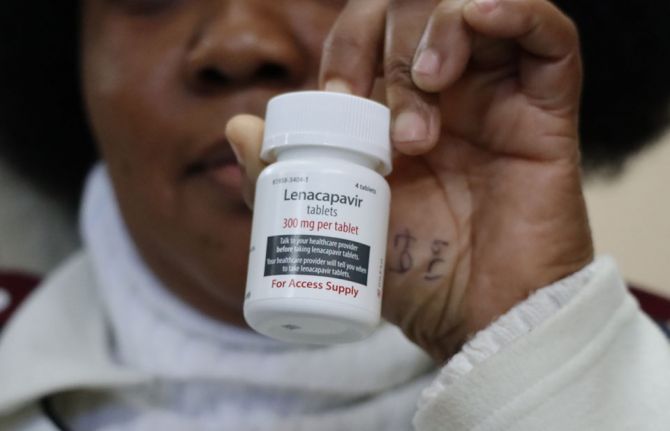
19 June 2026 19 June 2026History was made in the Mpumalanga province of South Africa on Friday, 5 June, as 21-year-old Jane Mndebele became the first person to receive lenacapavir, the twice-yearly HIV prevention injectable, as part of the country's new national prevention programme.
"I am excited," she said, after the injection was administered by Health Minister, Dr Aaron Motsoaledi himself. Her words captured the mood of thousands gathered at Lilian Ngoyi Stadium in Secunda, and of a global health community that has waited years for this moment.
South Africa, home to the world's largest HIV epidemic with an estimated 7.9 million people living with the virus, officially launched the national rollout of lenacapavir, becoming the ninth African country to do so.
"The launch of lenacapavir marks a turning point in our nation's fight against HIV. It represents the triumph of science over despair. It represents the power of innovation to save lives," said President Cyril Ramaphosa. He was careful, however, to frame the injection as one tool among many. "It is one more powerful tool in our arsenal. It complements HIV testing, oral PrEP, treatment as prevention, condoms, voluntary medical male circumcision, and behavioural interventions."
Lenacapavir is a powerful new option, but it works best as part of a broader package. UNAIDS stresses that the injection must be integrated alongside condoms, family planning, sexual and reproductive health services, and community-based HIV prevention programmes. Evidence from programmes such as DREAMS has shown that when HIV prevention is combined with education, economic opportunity, protection from violence, and safe spaces for young women, the results are transformative. UNAIDS data shows that girls who complete secondary education have a 50% lower risk of HIV infection.
The stakes are stark. South Africa recorded approximately 150,000 new HIV infections in 2024, with women and girls accounting for 59% of those. Over 71,000 were among adolescent girls and young women aged 15 to 24, equivalent to more than 1,000 newly infected young women every week. The government's decision to prioritise this group in the rollout of lenacapavir is both welcome and significant.
Alankar Malviya, UNAIDS Multi-Country Director for South Africa, Lesotho and Eswatini, welcomed the commitment. "President Ramaphosa has demonstrated political will to continue on a path to transform the HIV response. We welcome the prioritisation of adolescent girls and young women, men who have sex with men, sex workers and people who use drugs," he said, adding that UNAIDS welcomes ongoing discussions between Gilead Sciences and the government to explore local generic production.
For UNAIDS, the launch is both a milestone and a call to action. "Today is a day many of us here in South Africa have waited for," said Anne Githuku-Shongwe, UNAIDS Regional Director for Eastern and Southern Africa. "For many of us who have worked in the HIV response, this moment feels almost unimaginable. Now we must make sure that this breakthrough does not become another example of scientific success and implementation failure."
The rollout begins at 360 public health facilities across six provinces and 24 high-burden districts, with a national target to reach close to one million people by end of 2027, and three million within three years. A combined investment of R1.3 billion from the Global Fund and the Children's Investment Fund Foundation, alongside government funding, will support the programme. Generic versions of lenacapavir are expected from 2027 at around USD 40 per person per year, a dramatic reduction from the tens of thousands of dollars charged in high-income countries, though affordability at scale remains a challenge for many countries facing shrinking health budgets.
For now, Jane Mndebele and the thousands of South Africans who will follow her to clinics in the coming weeks represent something real and hard-won: proof that with political courage, community partnership, and sustained investment, scientific progress can be made to serve the people who need it most.