Documents
Agenda item 6.1: Performance monitoring report 2025
30 June 2026

Documents
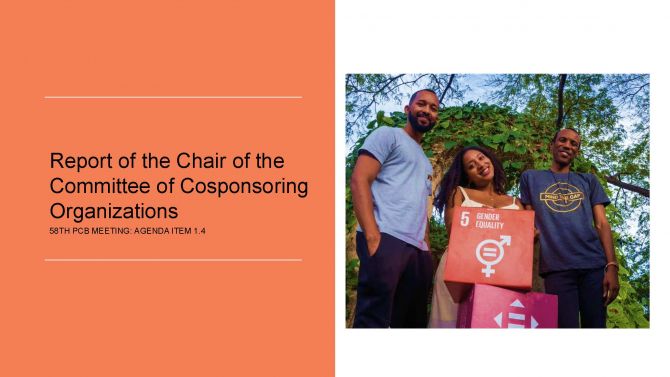
Agenda item 1.4: Report of the Chair of the Committee of Cosponsoring Organizations (CCO)
30 June 2026
Documents
Agenda item 5: Statement by the representative of the USSA
30 June 2026
Documents
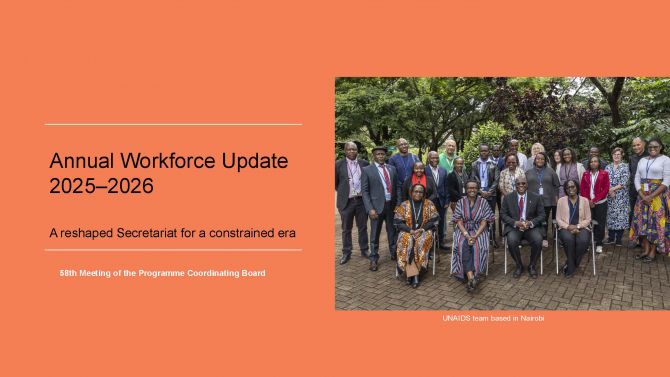
Agenda item 4: Update on strategic human resources management issues
30 June 2026
Documents
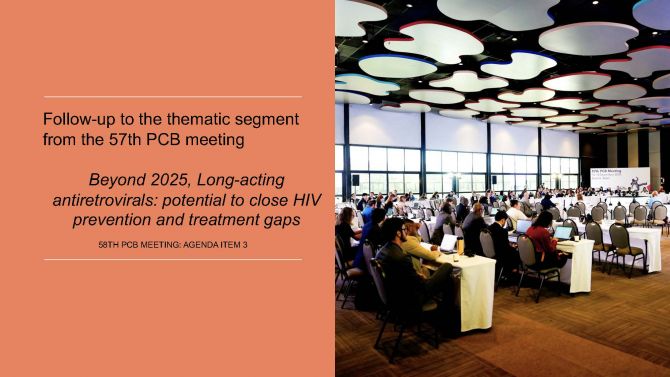
Agenda item 3: Follow-up to the thematic segment from the 57th PCB meeting
30 June 2026
Documents
Agenda item 8: Interim Report of the PCB Working Group
30 June 2026
Documents
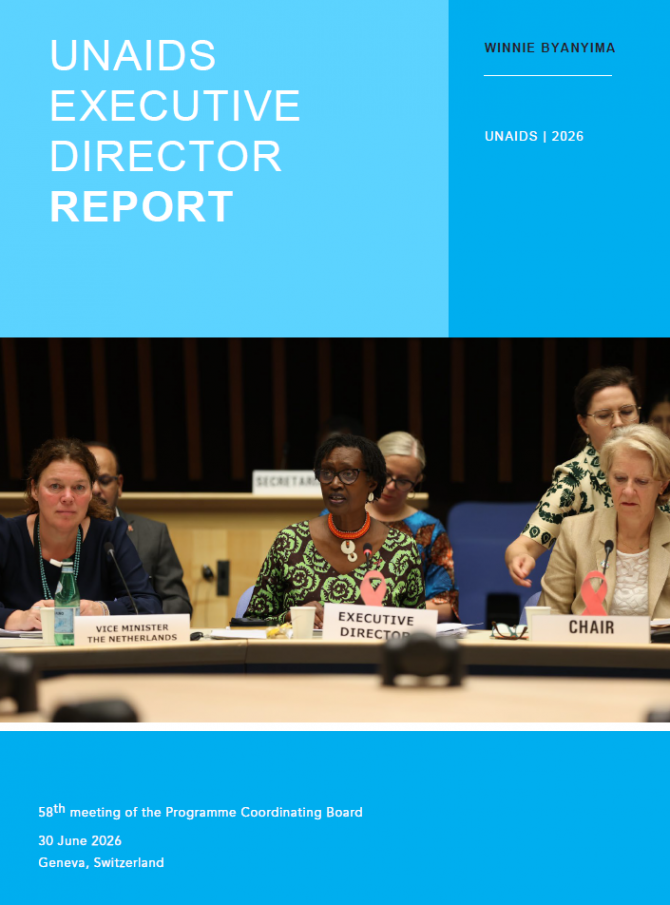
UNAIDS Executive Director's report to the 58th meeting of the Programme Coordinating Board
30 June 2026
Documents
List of Participants
29 June 2026

Feature Story
The 2026 UN Political Declaration on HIV/AIDS: Accelerating progress towards ending AIDS as a public health threat
29 June 2026
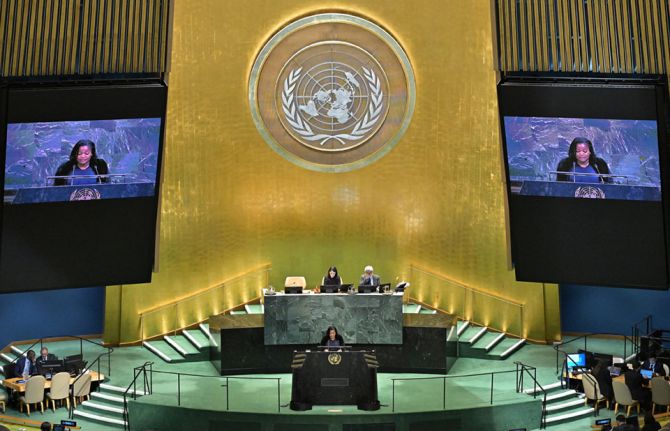
29 June 2026 29 June 2026On 22-23 June 2026, UN Member States convened at the UN General Assembly High-Level Meeting in New York to consider and agree a new Political Declaration on HIV/AIDS. The agreement sets out the global priorities, targets and actions that will guide the HIV response over the next five years and accelerate progress towards ending AIDS as a public health threat by 2030.
The 2026 UN Political Declaration on HIV/AIDS was adopted by an overwhelming majority of Member States, with 149 votes in favour, 8 against and 14 abstentions.
Note: References in parentheses (e.g. P60) refer to the corresponding paragraph numbers in the 2026 UN Political Declaration on HIV/AIDS.
The following highlights the key aspects of the 2026 UN Political Declaration on HIV/AIDS:
Topline Targets of the 2026 Political Declaration
By adopting a new Political Declaration on HIV/AIDS that reflects the targets of UNAIDS’ Global AIDS Strategy 2026–2031, Member States endorsed new, bold commitments that, if fully achieved, will avert an additional 3.2 million new HIV infections and 1.3 million AIDS-related deaths by 2030.
The 2026 Political Declaration includes all 16 of the 2030 targets contained in the Global AIDS Strategy 2026-2031, as well as additional new targets agreed by Member States. These targets include:
- Treatment and prevention scale-up: Two critical, new global milestones: reaching 40 million people living with HIV with life-saving HIV treatment – including 38 million with a supressed viral load - (P60) and 20 million people with ARV-based prevention by 2030 (P57).
- Reaffirming the 95-95-95 targets: Recommits to the 95-95-95 targets for HIV testing, treatment and viral suppression by 2030 (P61).
- Securing sustainable financing: A new global financing commitment of US$21.9 billion annually by 2030 (P48b), backed by explicit pledges to sustain domestic and international funding and minimize out-of-pocket health expenditures (P46).
- Ensuring the protection of human rights, including gender equality, and ending HIV-related stigma, discrimination and violence: A renewed commitment – with specific, measurable targets – to protect human rights, achieve gender equality, empower all women and girls and end HIV-related stigma, discrimination and violence (P73).
- Achieving the 2030 targets for rates of new HIV infections and AIDS-related deaths: A recommitment to a 90% reduction in new HIV infections and AIDS-related deaths by 2030 (P90) – the agreed definition for ending AIDS as a public health threat after which countries can move from mitigating an epidemic to managing chronic disease - a different, more manageable, mission.
Core Pillars of the 2026 Political Declaration
1. Advancing people-centered HIV prevention and treatment for people living with, affected by or at risk of HIV
- Comprehensive prevention: New, measurable target to ensure 90% of all people in need are reached with effective prevention options, including condoms, PrEP and harm reduction (P56).
- Explicit focus on key populations: Places greater, explicit emphasis on key populations across all areas of the HIV response, acknowledging that ending AIDS is impossible without reaching and empowering these communities (P58).
- Gender equality, empowering women and girls: Reaffirms the structural necessity of reaching women and girls with comprehensive education and fulfilling all human rights for women and girls, including their sexual and reproductive health and reproductive rights (P59).
- Eliminating vertical transmission: Includes bold targets to achieve the elimination of vertical transmission of HIV and to end pediatric AIDS and ensures comprehensive care for women and children living with HIV (P69).
2. Community leadership, equity and rights
- Empowering communities: Formally reinforces community-led responses by committing to expanded social contracting and community-led monitoring supported by increased funding. Also calls for institutionalizing the 30-80-60 targets for community-delivered services (P94).
- Protecting civic space and human rights: Newly commits to enabling a civic space for civil society and recommits to the 10-10-10 targets calling for the lifting of HIV-related stigma and discrimination, punitive legal barriers and violence against women and key populations (P73).
3. Access to medicines, integration and accountability
- Access to medicines and technology Transfer: Commits to ensuring the global accessibility, availability and affordability of quality-assured HIV medicines, diagnostics, vaccines and other essential health technologies through tailored technical assistance and technology transfer (P85), while also supporting the rapid scale-up of innovations, including long-acting formulations (P68).
- Integration: Introduces an ambitious integration agenda with new targets for integrating HIV services into maternal, child, and sexual/reproductive health services, alongside integrated HIV/TB services to sharply reduce TB-related deaths (P65).
- Scientific discovery: Outlines a full agenda and commitment to advance long-term scientific research for an HIV vaccine and a cure (P51).
- Data and accountability: Commits to strengthening disaggregated data and accountability systems at country level, including through investment in community-led monitoring (P54).
4. Financing the Future of the HIV Response
- Scaling-up sustainable financing: Commits to mobilize $21.9 billion annually by 2030 for HIV in low- and middle-income countries (P48b), through predictable, adequate and diversified funding from domestic and international sources (P48).
- Closing critical funding gaps: Prioritizes fully financing HIV prevention and societal enablers, recognizing that prevention is essential to ending AIDS (P49), and strengthens HIV financing for community-led responses (P54, P94).
- Strengthening domestic investment and transition: Supports sustainable financing models to enable a gradual shift toward domestic funding without disrupting services, with reduction of out-of-pocket expenditures and advancement of universal health coverage, and promotion of national health sovereignty (P50).
5. Renewed Support for Multilateralism
- International Partners: The 2026 Political Declaration recognizes the leading role played by the Joint UN Programme on HIV/AIDS (UNAIDS) in coordination, technical cooperation, monitoring and support to national AIDS responses over the last 30 years (P9a), as well as achievements of the Global Fund to Fight AIDS, Tuberculosis and Malaria, Unitaid and their partners in financing the implementation of country-led HIV responses (P9b).
- Annual Reporting and HLM 2031: Commits Member States to submit annual progress reports to UNAIDS, using robust, disaggregated data to pinpoint gaps in service coverage and HIV response outcomes (P97), and convene the next UNGA high-level meeting in 2031 to review progress (P100).
Related resources
Documents
Agenda item 9: Thematic Segment Agenda
30 June 2026